
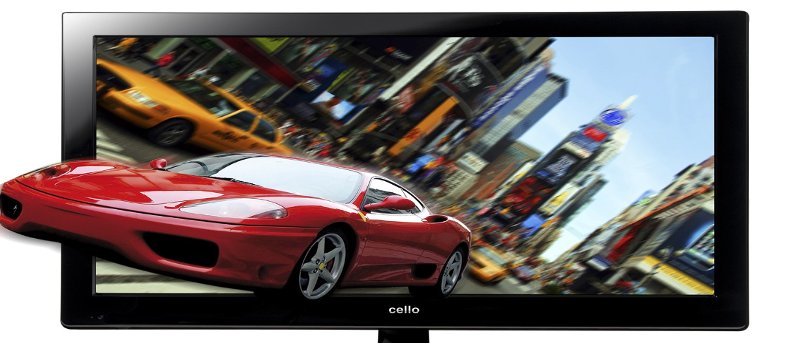

Whether you plan on buying a 3DTV, a 3D monitor, or a 3D-capable DLP projector, you’re going to have to do some homework before making a decision. Today, the market is flooded with different types of 3D capabilities, each with their advantages and disadvantages. What’s troubling about this kind of market is the excessive omission behind the disadvantages of each technology. This article will discuss each 3D technology in a transparent way and even present a little history.
Passive/Active 3D & Anaglyph

There are a myriad of monitors that can render 3D movies and games, but most of them fall into two different categories: active and passive 3D.
All 3D equipment works much the same – it takes two different images and shows you both at the same time with slight differences that trick the eyes into perceiving the presented objects at different depths. This concept is known as stereoscopy.
Not too long ago, stereoscopic images were rendered by the eyes through red and blue (cyan) glasses. The displays would present an image with slightly displaced red and blue tints, making objects seem closer than they really were. This is known as anaglyph 3D. It’s an outdated technology that doesn’t really let you see sharp images with deep colors.
Recent developments in 3D technology have successfully made screens that can show you images with brilliant colors. This is where active and passive 3D comes in.
Passive 3D
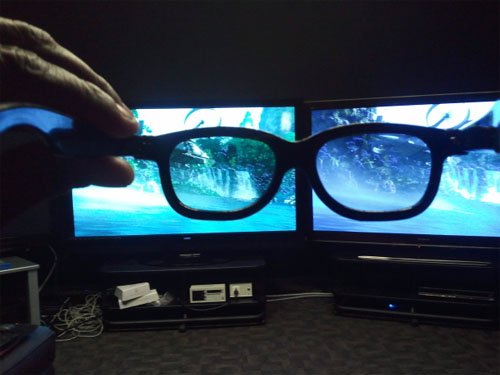
With passive 3D, a viewer is required to wear a pair of circular-polarized glasses. Each lens on the glasses filters a different image. While both images are presented by your display, each image’s light is polarized separately. The left image is polarized in one direction and the right image in the opposite direction. The glasses will filter each image according to the direction in which it flows. Passive 3D monitors function by polarizing light in different directions.
Active 3D
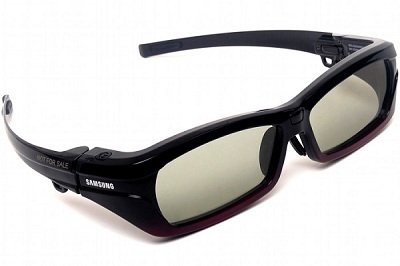
In active 3D, monitors and glasses both synchronize to produce a 3D image. The glasses have shutters that alternate between the left and right eye. The monitor quickly alternates the left and right image in sync with the glasses. Each eye sees its image with the refresh rate being so high that the shutter effect isn’t noticed. It eliminates many of the problems experienced in 3D movies.
Glasses-Free
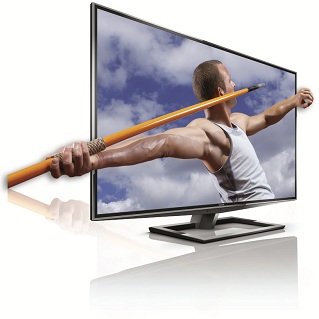
The technology known as “glasses-free 3D” is still kind of new and presents new problems. As the name suggests, you don’t need any glasses to view an image. The system works by presenting left and right images at the same time (like Passive 3D), but in a way in which the light reaches the eyes separately. This requires no polarization, since the light separation occurs through screen mechanisms rather than through the glasses.
There are two types of glasses-free systems. Both of them actually use very old technologies that form what is known as autostereoscopy.
The first one, known as parallax barrier stereoscopy, puts a barrier between left and right pixels, directing light at two different locations so that each image goes to a separate eye.
The second one, known as lenticular array stereoscopy, places a curved lens between each left and right pixel so that light is refracted in two different directions, landing on each eye separately.
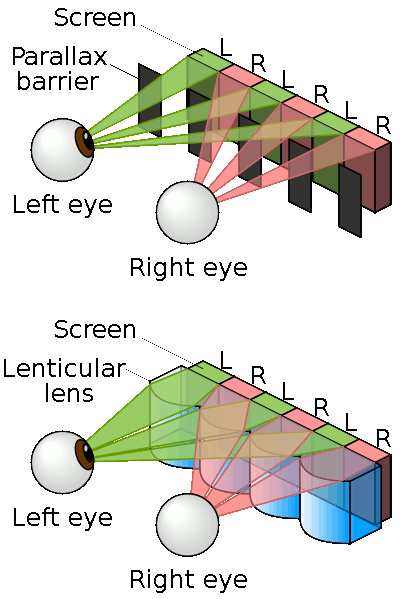
Both technologies are seen in different displays, and each one is suitable for a particular purpose. Parallax barriers, for example, are ideal in environments where the viewer is relatively close to a small display. Lenticular arrays are often used in larger displays.
Active 3D vs. Passive 3D Overview
Passive 3D:
Pros:
- Glasses are considerably light.
- Monitor and glasses are always compatible.
- The technology is considerably affordable, with glasses costing anywhere from $2 to $30 for a pair and monitors ranging from $400-600.
Cons:
- The polarization on the glasses can bleed out colors when you tilt your head.
- Vertical angles of more than ten degrees can cause images to look distorted (ghosting).
Active 3D
Pros:
- Viewing angles are much more permissive.
- No color bleeding is experienced.
- Users often report that they see more vibrant images through active 3D monitor technology.
Cons:
- Images might appear more dim than usual because of the liquid crystal lens. Some Samsung models actually have addressed this issue. You can solve this by raising the brightness of the monitor.
- You might get headaches, depending on how sensitive you are to the shutter effect.
- The shutters might be visible under certain lighting conditions and when the battery starts to drain.
- The glasses are slightly heavy because of the batteries.
- Monitors and glasses are very expensive, with glasses costing you about $100 a pair and monitors costing from $800-1500.
- The glasses must be compatible with the viewing monitor.
Problems Presented By Glasses-Free Technology
In light of this new technology, there’s only one advantage: You don’t have to wear glasses. But have a look at these issues you may experience with glasses-free 3D technology:
- Horizontal viewing is highly limited. There are only a number of angles movies can be viewed in. Any other angles will cause distortion. Also, viewers have to be seated within that narrow viewing area to enjoy the glasses-free effect. This may present problems when you have many guests or just want to lay down to watch a movie.
- Because of the filters on the screen, you may see background objects rather blurry. This may cause some discomfort that’s difficult to adjust to.
Aside from that, glasses-free 3D has many of the same problems that other technologies have. Not only are they usually more expensive than active 3D displays, but they also really don’t fix anything. If money isn’t an issue, consider getting active 3D rather than glasses-free.
How Movies Are Played in 3D
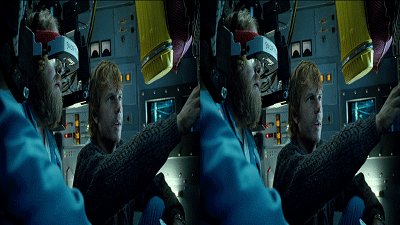
The most popular method of playing a movie in 3D is the “side-by-side” (SBS) method. In this method, frames are compressed into half their width and each image (left and right) is shown in its respective position. A 3D monitor combines the two images and polarizes the light emitted or alternates between the two images rapidly.
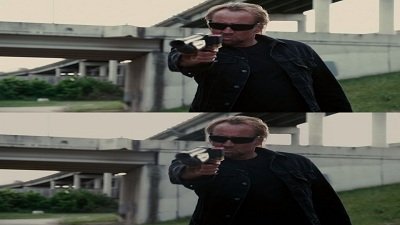
There’s another method, called the top-and-bottom (T/B) method, which does much of the same thing as SBS, only it compresses the frame height not the width.

The third method of 3D is the native interleave method, where both images are already combined, and the monitor passes the data on in the form of light.
A Word Or Two About DLP Projectors
Since DLP projectors generate light through a lamp and present an image reflected from a surface, they obviously don’t have as much flexibility in 3D capabilities as monitors or TVs do. You probably won’t get such vibrant colors if you get a passive 3D DLP projector. The recommendation is get an active 3D setup. Keep this in mind when buying a projector. If you like the 3D movies you see at the cinema, a passive 3D projector will be adequate for you. But if you want the full resolution and all nine yards, as well as a higher tolerance for viewing angles, you should definitely get an active projector!
Questions?
If you have any further questions on 3D technology, please post in the comment section below. If you have something to add to this discussion, please mention that below as well.